
Agricultural Abundance: America's Food Future
Transforming Food Production for the Next Quarter Century
Howard Roark
12/31/20257 min read
The story of human civilization is inseparable from the story of agriculture. Every major leap forward in our collective prosperity has been preceded by innovations in how we grow, distribute, and consume food. Today, we stand at the threshold of another agricultural revolution, one that promises not just incremental improvements but a fundamental reimagining of how America feeds itself and the world.
American Elysium envisions an era of true agricultural abundance, where advanced technologies, sustainable practices, and precision systems converge to create a food production system that is more efficient, more resilient, and more bountiful than anything in human history. This is not a distant dream but an achievable reality within the next twenty-five years.
The Current Landscape and Its Challenges
American agriculture today is simultaneously a marvel and a concern. We produce more food per acre than ever before, yet we face mounting challenges: supply chain vulnerabilities exposed by recent global disruptions, environmental pressures from conventional farming practices, water scarcity in key agricultural regions, and the inefficiencies of a system where food often travels thousands of miles from farm to table.
Traditional farming, while productive, operates under constraints that technology can now transcend. Seasonal limitations, geographic restrictions, weather dependence, and the vast land requirements of conventional agriculture all point toward the need for a new paradigm. The question is not whether we should transform our agricultural systems, but how quickly we can make that transformation a reality.
The Three Pillars of Agricultural Abundance
Advanced Agriculture: Enhancing Traditional Farming
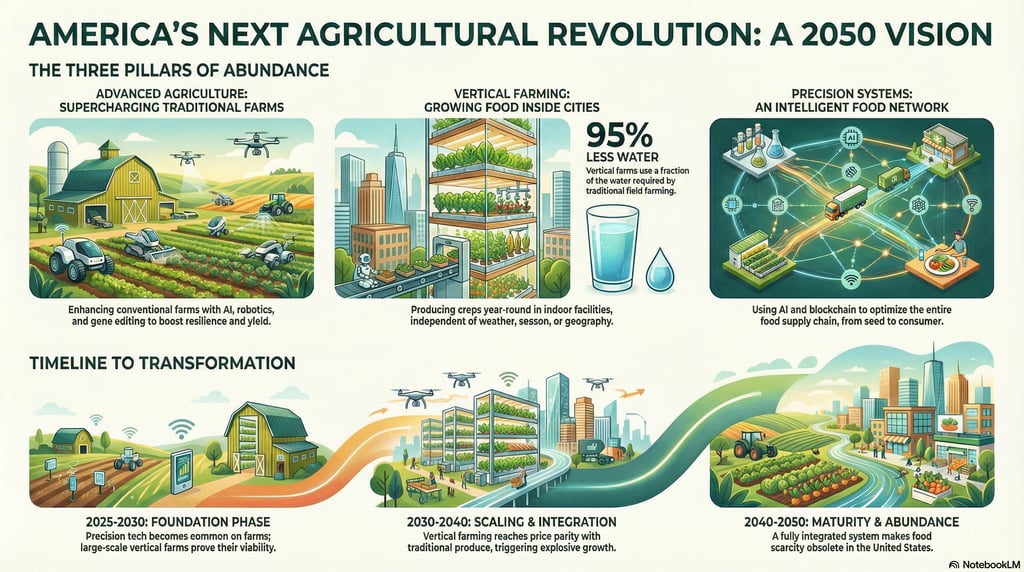
The foundation of agricultural abundance begins with revolutionizing traditional farming through precision agriculture technologies. Over the next decade, we will see the widespread adoption of AI-driven farm management systems that optimize every aspect of crop production. Sensors embedded throughout fields will monitor soil moisture, nutrient levels, and plant health in real-time, allowing for precise application of water and fertilizers exactly where and when they're needed.
Autonomous systems will handle planting, monitoring, and harvesting with unprecedented efficiency. Drones equipped with multispectral imaging will identify pest infestations or nutrient deficiencies before they become visible to the human eye, enabling targeted interventions that reduce chemical use while improving yields. GPS-guided tractors and robotic harvesters will work around the clock, dramatically reducing labor costs and increasing productivity.
Gene editing technologies like CRISPR will create crop varieties optimized for specific conditions: drought-resistant wheat for arid regions, flood-tolerant rice for changing climate patterns, and nutrient-enhanced vegetables that deliver more vitamins and minerals per serving. These advances will not replace traditional crops but will enhance them, making American farms more productive and more resilient.
Vertical Farming: Agriculture Reimagined
While advanced traditional agriculture will remain crucial, vertical farming represents a genuinely transformative approach to food production. These indoor facilities, rising in urban and suburban areas across America, will produce crops year-round, independent of weather, season, or geography.
Within the next fifteen years, vertical farms will become a common sight in American cities. Multi-story facilities will grow lettuce, herbs, strawberries, tomatoes, and dozens of other crops using hydroponic or aeroponic systems that require 95% less water than traditional farming. LED lighting tuned to specific wavelengths will optimize photosynthesis, while AI-controlled environments will maintain perfect growing conditions twenty-four hours a day.
The advantages extend beyond efficiency. Vertical farms eliminate the need for pesticides in controlled environments, produce higher nutritional value in faster-growing plants, and dramatically reduce transportation costs and emissions by locating production near consumption centers. A vertical farm in downtown Dallas can harvest fresh produce in the morning and have it on store shelves that afternoon, maximizing freshness while minimizing the carbon footprint.
By 2050, vertical farms could supply 30-40% of America's fresh produce, particularly leafy greens and herbs. The land currently used for these crops could be repurposed for grains, proteins, or returned to natural ecosystems, creating a more efficient allocation of our agricultural resources.
Precision Systems: Intelligence at Every Level
The integration of precision systems across all aspects of food production will be the connective tissue that binds advanced agriculture and vertical farming into a coherent, optimized whole. This encompasses everything from seed to supermarket, creating an intelligent food system that wastes less, produces more, and responds dynamically to changing conditions and demands.
Machine learning algorithms will analyze weather patterns, market demands, and resource availability to guide planting decisions months in advance. Blockchain technology will provide complete transparency and traceability throughout the supply chain, allowing consumers to know exactly where their food came from and how it was produced. Smart logistics systems will optimize transportation routes and storage conditions to minimize spoilage and reduce costs.
At the consumer level, precision systems will help reduce household food waste through smart packaging that monitors freshness and mobile applications that help families plan meals and purchases more efficiently. The result will be a food system where intelligence operates at every node, constantly optimizing for efficiency, sustainability, and abundance.
The Timeline: 2025-2050
The transformation toward agricultural abundance will unfold in distinct phases, each building on the last.
Phase One (2025-2030): Foundation and Early Adoption will see the rapid expansion of precision agriculture technologies on conventional farms, with adoption rates reaching 60-70% among major agricultural operations. The first generation of large-scale commercial vertical farms will come online in major metropolitan areas, demonstrating the viability of the technology at scale. Gene-edited crops will gain regulatory approval and begin commercial production, while autonomous farming equipment will become standard rather than experimental.
Phase Two (2030-2040): Scale and Integration will witness vertical farming reaching price parity with traditional produce for most crops, leading to explosive growth in the sector. Advanced agriculture systems will become nearly universal among commercial farms, with small and medium operations gaining access to these technologies through cooperative models and equipment sharing. The integration of renewable energy with agricultural operations will make many farms net-zero or even net-positive in energy production. Cellular agriculture will mature, providing sustainable alternatives for certain proteins and ingredients.
Phase Three (2040-2050): Maturity and Abundance will deliver the full realization of agricultural abundance. Vertical and advanced agriculture will operate as a seamlessly integrated system, with AI coordinating production across both domains to optimize for freshness, nutrition, cost, and sustainability. Food production will have largely decoupled from environmental constraints, with American agriculture producing more food on less land while using fewer resources. The concept of food scarcity in America will become obsolete, replaced by a food system so efficient and abundant that the primary challenges shift to ensuring equitable distribution and minimizing waste.
Economic and Social Implications
The economic transformation accompanying agricultural abundance will be profound. The agricultural sector will grow significantly in value while requiring less land and fewer resources, creating new categories of high-skilled jobs in agricultural technology, data science, and systems management. Rural communities will benefit from the higher value and reduced risk of precision agriculture, while urban areas will see job creation in vertical farming operations.
Food costs as a percentage of household income will decline for most Americans, even as food quality and nutritional value improve. The combination of increased efficiency, reduced transportation costs, and year-round production will make fresh, healthy food more accessible to communities that currently face food insecurity.
The social implications extend beyond economics. When a nation achieves true food abundance, it transforms the relationship between citizens and their most basic needs. Food security becomes a given rather than a concern, freeing human creativity and energy for other pursuits. Communities gain resilience against disruptions, whether from climate events, geopolitical tensions, or other unforeseen challenges.
Environmental Benefits and Sustainability
Perhaps the most compelling argument for agricultural abundance through advanced systems is the environmental benefit. By producing more food on less land, we can return millions of acres to natural ecosystems, creating corridors for wildlife and carbon sinks that help address climate change. Precision agriculture dramatically reduces fertilizer and pesticide runoff, protecting waterways and aquatic ecosystems. Vertical farming eliminates agricultural runoff entirely while using a fraction of the water.
The reduction in food transportation will cut millions of tons of carbon emissions annually. Local production through vertical farming means less refrigerated trucking, less spoilage, and fresher food. When combined with renewable energy integration, American agriculture could transition from a significant source of emissions to a near-neutral or even carbon-negative sector.
Challenges and How We'll Overcome Them
The path to agricultural abundance faces real challenges that we must acknowledge and address. The initial capital costs for vertical farming and advanced agricultural systems are substantial, though rapidly declining. Regulatory frameworks need to evolve to accommodate new technologies, particularly in gene editing and cellular agriculture. There will be workforce transitions as some traditional farming roles become automated, requiring retraining and new skill development.
These challenges are surmountable with the right policies and investments. Public-private partnerships can help small and medium operations adopt new technologies. Regulatory sandboxes can allow for safe innovation while protecting public health and environmental standards. Workforce development programs can ensure that rural communities benefit from rather than be disrupted by technological change.
The bigger risk is not in attempting this transformation but in failing to pursue it. Agricultural abundance is not merely desirable; it is increasingly necessary as we face a future of climate uncertainty, water scarcity, and global population growth.
A Vision of Abundance
Imagine an America in 2050 where agricultural abundance is simply the norm. Urban towers grow fresh produce year-round while automated farms in the heartland produce grains and proteins with unprecedented efficiency. Families have access to fresh, nutritious, affordable food regardless of their zip code or income level. Farmers operate sophisticated systems that are both more profitable and more sustainable than anything their grandparents could have imagined.
This is not utopian fantasy but achievable reality. The technologies exist or are rapidly maturing. The economic case is compelling. The environmental benefits are undeniable. What remains is the collective will to make it happen.
American Elysium's vision for agricultural abundance is ultimately a vision of human flourishing. When we ensure that our most basic needs are met with efficiency and sustainability, we free ourselves to reach for higher aspirations. Agricultural abundance is not the end goal but the foundation upon which we can build a society of unprecedented prosperity, creativity, and opportunity.
The next quarter century will determine whether America leads this agricultural revolution or follows others who seize the opportunity. The choice is ours, and the time to act is now. Agricultural abundance awaits, transforming not just how we grow food but how we live, work, and imagine our collective future.