
The Continental Artery: Reviving the American System via High-Throughput Cargo Hyperloops
A great civilization is defined by the velocity of its commerce. When Henry Clay outlined his visionary “American System” in the early 19th century, he understood a fundamental truth: a nation cannot maintain internal cohesion, economic independence, or rapid growth without a unified network of internal improvements. Clay’s triad of protective tariffs, a strong financial system, and federally backed roads and canals laid the groundwork for an industrial empire that bound distant states into a single, formidable economy.
Today, the physical backbone of American logistics is reaching its absolute limits. Our highways are choked with long-haul freight, our rail corridors operate on centuries-old right-of-ways, and supply chains remain vulnerable to systemic disruption. If we are to build an American Elysium, we must apply systems-level design to modern transportation. We must upgrade Clay’s vision for the 21st century by constructing the ultimate continental artery: a nationwide, high-throughput hyperloop system built exclusively for rapid cargo transport.
The New Internal Commerce: One Hour Across the Continent
The modern American System requires moving physical goods at the speed of the digital age. By building a dedicated terrestrial hyperloop network operating in near-vacuum tubes, we can move heavy cargo across the nation at near-mach speeds with unprecedented reliability and zero atmospheric resistance.
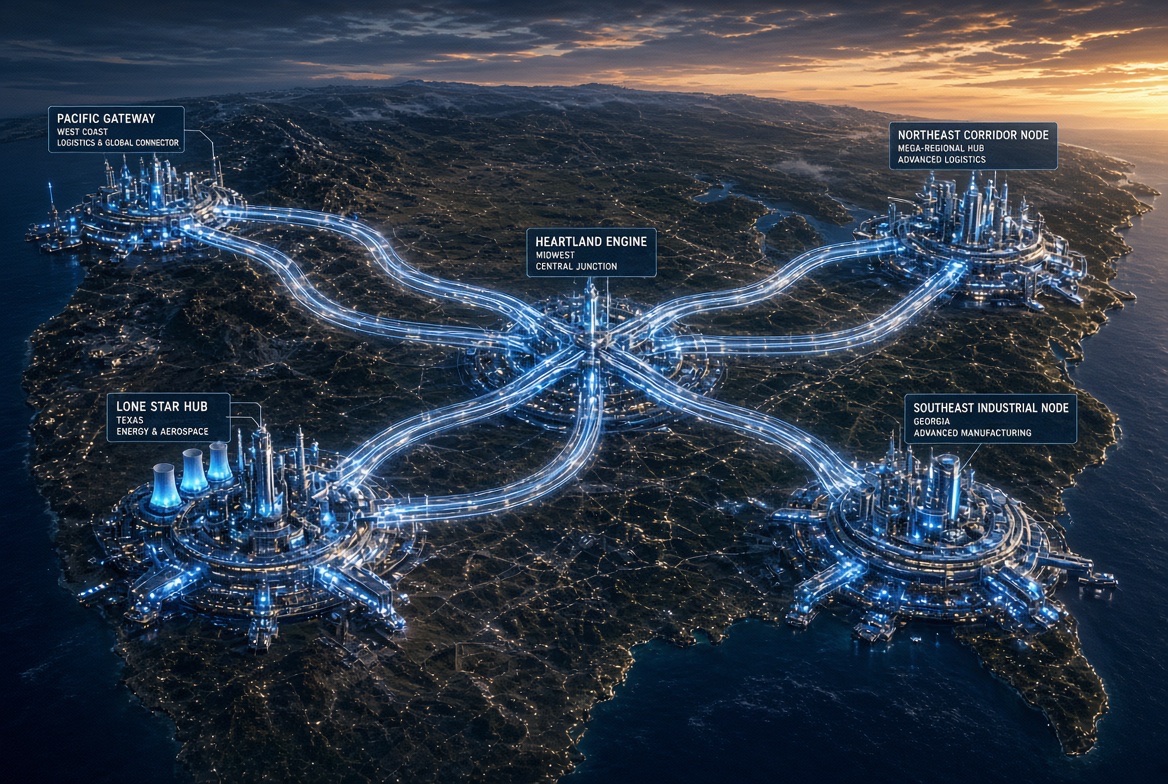
Imagine a network of massive terrestrial ports strategically placed in key industrial, agricultural, and research hubs across the United States:
- The Lone Star Hub (Texas): Linking energy refining, advanced aerospace, and heavy manufacturing.
- The Southeast Industrial Node (Georgia): Connecting deep-water maritime trade with booming regional logistics.
- The Northeast Corridor Node: Tying high-tech research, financial capital, and advanced biotechnology into the network.
- The Heartland Engine (Midwest): Serving as the central junction for heavy industry, agricultural output, and advanced materials.
- The Pacific Gateway (West Coast): Integrating global Pacific trade with domestic high-tech manufacturing.
Through this network, cargo pods from Texas can arrive in the Midwest or the West Coast in one hour or less. Distance becomes irrelevant to domestic production. Inventory holding costs vanish, supply chains become instant, and the friction that stifles regional trade is erased.
Terrestrial Ports: The Epicenters of Modern Industry
These are not standard distribution centers or dusty railyards. They are giant, next-generation terrestrial ports that will become epicenters of innovation, manufacturing, and cutting-edge automation.
At each portal, automated logistics systems will unload, sort, and route high-density cargo in minutes using AI-driven robotics and magnetic levitation trackwork. Surround each port with advanced industrial parks, and you create a self-reinforcing flywheel of economic productivity:
- Precision Manufacturing: High-value components created at one hub can be transported instantly to another for final assembly, uniting specialized regional economies into a single high-output assembly line.
- Autonomous Last-Mile Delivery: Goods arriving at the hyperloop terminal transition immediately to local autonomous electric fleets, guaranteeing rapid delivery to local markets without straining inter-state highways.
- Resilient Supply Chains: By removing reliance on weather-dependent freight routes and diesel-burning long-haul trucks, national trade gains absolute immunity to weather disruptions and fuel price volatility.
Powered by Abundance: Gigawatt-Scale Nuclear Anchors
Moving millions of tons of cargo at supersonic speeds demands massive, continuous, and uninterrupted power. To ensure complete energy independence and absolute reliability, each terrestrial port will be anchored by its own gigawatt-scale nuclear power complex.
These advanced nuclear plants will provide dedicated baseload power directly to the hyperloop propulsion systems, magnetically levitated tracks, and automated port operations. Furthermore, the excess clean electricity and high-temperature process heat generated at each hub will power on-site advanced manufacturing, chemical synthesis, and regional microgrids.
By situating these mega-projects on federal lands, we can streamline environmental permitting and ensure rapid deployment, while operating each port in direct partnership with local state governments. This cooperative model honors local sovereignty, creates tens of thousands of high-wage technical jobs in every host state, and ensures that the economic gains generated by the hub directly benefit the surrounding communities.
Completing the American Blueprint
Henry Clay recognized that a nation divided by geography and hampered by slow transport could never achieve its full potential. The hyperloop cargo network fulfills his promise, elevating our national logistics into a Tier-1 civilizational capability.
By combining near-vacuum tube transport, gigawatt-scale nuclear power, advanced robotics, and state-federal partnership, we eliminate the physical constraints that hold back American productivity. We bind the country into an integrated, self-sustaining economic powerhouse, securing our industrial independence and opening the door to a new Golden Age.