The American ATLAS Framework: A Systems Approach to 21st Century Alliances
Replacing Ambiguity With Architecture
Howard Roark
12/25/20255 min read
American foreign policy operates without a coherent organizing logic. Nations with fundamentally different relationships to the United States, from deep security partners to commercial trading states, are discussed using the same vocabulary and treated with similar ambiguity. The result is alliance fatigue, misaligned expectations, inefficient resource allocation, and limited pathways for partners to deepen cooperation over time.
The American ATLAS Framework (American Trade, Law, Access & Security) addresses this problem by replacing ideology and ad hoc diplomacy with system integration. Rather than asking whether a nation shares American values or regional interests, ATLAS asks a more fundamental question: across how many foundational systems do our nations actually operate as one?
Seven Domains, Graduated Integration
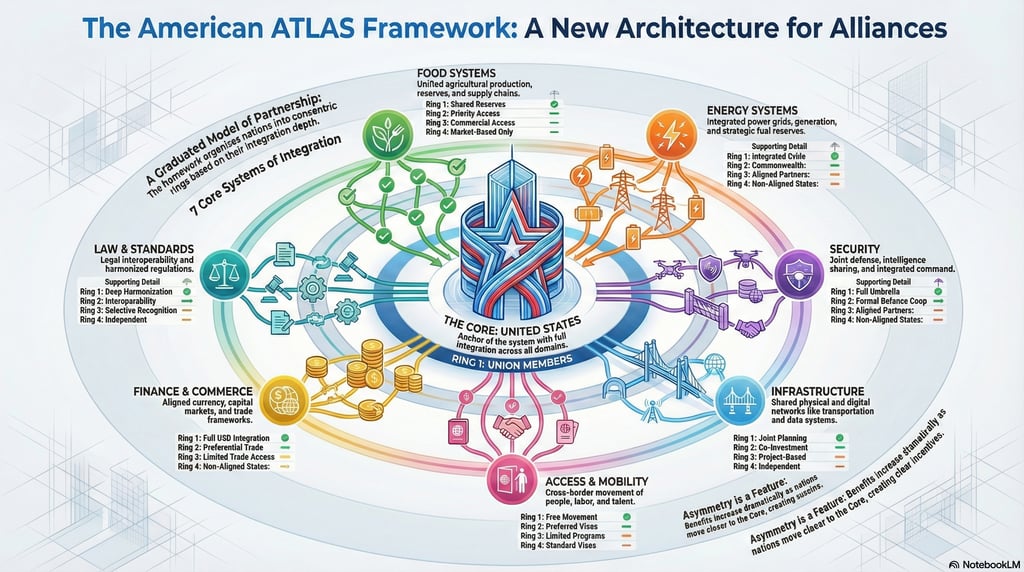
ATLAS evaluates relationships across seven core domains, the minimum systems required for functional international order and long-term prosperity:
Food Systems: Agricultural production, strategic reserves, supply chains, and emergency provisioning. Integration here provides supply predictability and insulation from global shocks.
Energy Systems: Generation, transmission, reserves, and long-term supply agreements. Energy integration enables industrial planning and strategic autonomy.
Security: Defense cooperation, intelligence sharing, logistics, cyber, and maritime security. Security integration is the primary trust signal in any alliance system.
Infrastructure: The physical and digital substrate connecting nations. Transportation networks, energy grids, ports, and data systems create durable alignment through shared capital investment.
Access & Mobility: Movement of people, labor, and talent. Visa regimes and work authorization directly shape economic and human capital flows.
Finance & Commerce: Currency alignment, capital markets, trade frameworks, and investment protections. Financial integration lowers transaction costs and attracts long-term capital.
Law & Standards: Legal interoperability, arbitration, regulatory harmonization, and technical specifications. This is the trust layer that allows all other domains to function predictably.
These seven domains are not arbitrary categories. They represent the actual systems through which nations either cooperate deeply or operate independently. Alignment in one domain without others creates friction. Alignment across multiple domains creates compounding stability.
The Ring Structure: Proximity Determines Access
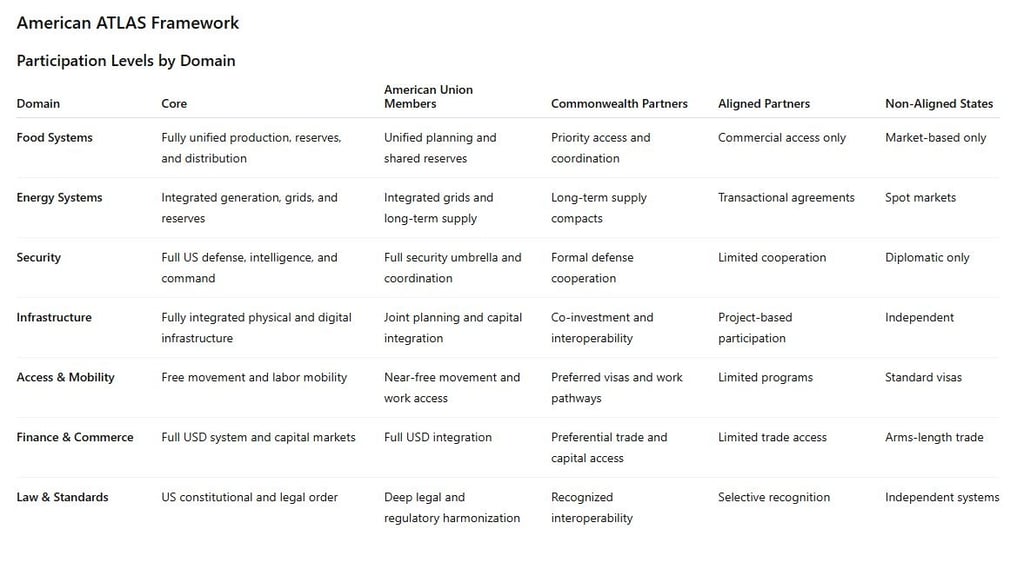
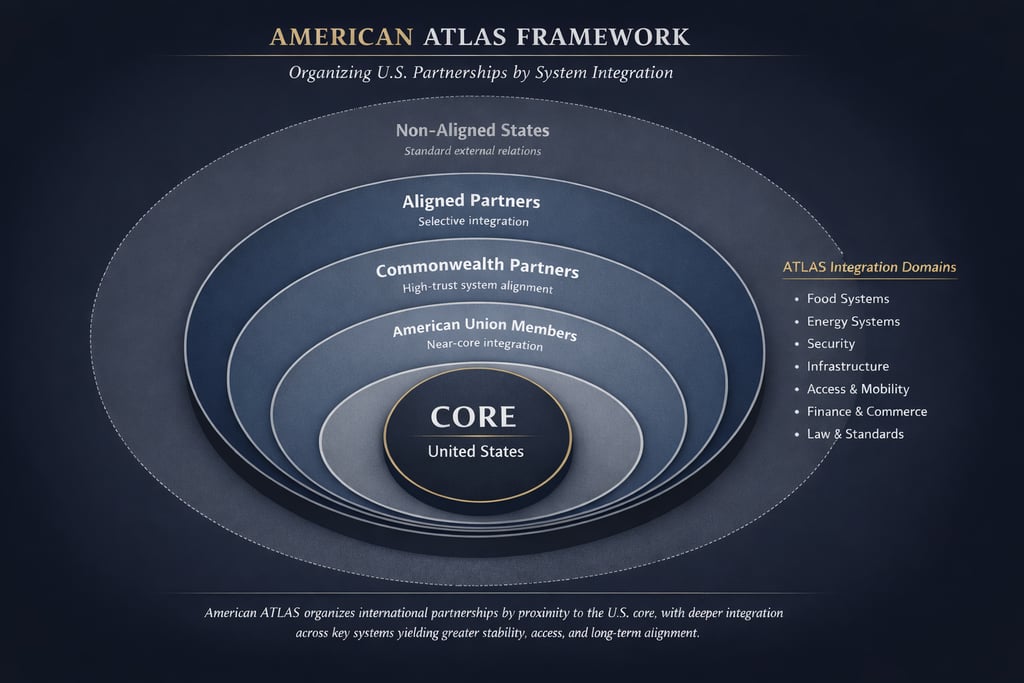
ATLAS organizes international relationships into graduated rings based on depth of integration across the seven domains. This replaces the binary logic of "ally versus non-ally" with a scalable model that reflects real-world variation.
American Core
The Core is the United States itself, the anchor and source of system standards. Full integration across all seven domains. Complete sovereign authority over currency, law, defense, and infrastructure. The Core remains stable and provides the gravitational center for all other rings.
Ring 3: Aligned Partners
Aligned Partners form the outer ring. They participate selectively across specific domains based on mutual interest. Integration is transactional rather than systemic.
Food and energy access operates through commercial channels only, with no priority treatment during disruptions. Security cooperation is limited and case-by-case. Infrastructure participation is project-based without broader system integration. Movement of people follows standard visa requirements with possible limited programs for specific sectors. Trade access may include sector-specific agreements but remains arms-length. Legal systems operate independently with selective recognition only in targeted domains.
This ring provides flexibility. Nations can access specific benefits without full commitment, and pathways exist for deeper integration over time if desired.
Ring 2: Commonwealth Partners
Commonwealth Partners form the backbone of America's global network. These nations maintain high-trust integration across multiple core domains without requiring Ring 1 level commitment.
Commonwealth nations receive priority access to food systems during global disruptions and participate in coordinated supply planning. Energy relationships operate through long-term supply compacts. Security cooperation is formalized through mutual defense commitments, substantial intelligence sharing, and joint planning across multiple domains. Infrastructure development proceeds through co-investment programs designed for interoperability. Visa and work authorization follows preferred pathways with expedited processing. Trade and capital access is preferential, with reduced transaction costs and favorable financing terms. Legal systems maintain recognized interoperability through aligned frameworks and mutual enforcement agreements.
Commonwealth Partners gain reduced volatility, enhanced access to American demand and capital, and participation in long-term strategic planning without requiring the full harmonization demanded of Ring 1 members.
Ring 1: American Union Members
American Union Members represent the highest level of partnership available. These nations achieve near-total integration across all seven domains while retaining distinct political identities.
In food systems, Union members participate in unified planning and share strategic reserves, treating agricultural security as a joint responsibility. Energy grids are integrated with long-term supply guarantees. Security cooperation is total: full intelligence sharing, integrated command structures, and unified defense planning. Infrastructure development proceeds through joint capital investment with coordinated standards. Movement of people approaches free mobility, with minimal barriers to work and residence. Financial systems achieve full USD integration, operating as extensions of American capital markets. Legal and regulatory frameworks are deeply harmonized, creating seamless commercial interoperability.
The result is maximum stability, predictable long-term planning, and preferential access to American markets, capital, and institutions. Union members functionally operate inside the American system while maintaining sovereign governance.
Non-Aligned States
Non-aligned states operate outside the ATLAS framework entirely. Engagement proceeds through standard diplomatic and commercial relations on a case-by-case basis.
Food and energy access is purely market-based with no coordination or priority access. Security engagement is diplomatic only, with no defense cooperation or intelligence sharing. Infrastructure development is independent with no joint planning or interoperability requirements. Movement of people follows standard visa processes with no preferential treatment. Commerce proceeds at arms-length through normal trade channels. Legal systems operate completely independently with no assumed compatibility.
This category is neutral and non-adversarial. It simply describes the absence of systematic integration. Non-aligned states may choose to remain outside the framework indefinitely, or they may pursue entry into Ring 3 if mutual interest develops.
Why Asymmetry Is a Feature, Not a Bug
ATLAS is intentionally asymmetric. Benefits increase dramatically as nations move closer to the Core. This gradient is not punitive. It reflects the reality that deeper integration requires higher trust, greater legal compatibility, shared standards, and long-term commitment.
In return for meeting these requirements, closer partners receive lower transaction costs, greater economic stability, preferential access to capital and markets, enhanced mobility for their citizens, and reduced exposure to global shocks. The incentive structure is clear without being coercive.
This design solves a persistent problem in alliance management: the absence of a structured upgrade path. Under ATLAS, nations can see exactly what deeper partnership requires and what benefits it unlocks. Ambiguity is replaced with architecture.
Strategic Advantages for American Foreign Policy
ATLAS provides the United States with several concrete improvements over current practice.
It clarifies alliance expectations by making explicit what each level of partnership entails. It aligns resource allocation with integration depth, ensuring that investment matches commitment. It reduces ambiguity in trade, security, and access decisions by providing a common analytical framework. It creates structured upgrade pathways that reward nations for deepening cooperation. It improves long-term planning across administrations by establishing durable categories that outlast political cycles.
Perhaps most importantly, ATLAS allows American foreign policy to move from reactive diplomacy to system design. Rather than managing relationships on an ad hoc basis, the United States can build and maintain an integrated international order with clear rules, predictable benefits, and room for growth.
From Ideology to Integration
The central insight of ATLAS is this: durable international order is not built on shared ideology or abstract values. It is built on shared systems, the practical infrastructure of food, energy, security, commerce, law, and mobility that determines whether nations can operate together reliably over decades.
By measuring integration across these concrete domains rather than rhetorical alignment, ATLAS provides a foreign policy framework suited to a complex, multipolar world. It rewards functional compatibility. It creates clear incentives. It allows flexibility where needed and depth where possible.
Most importantly, it replaces the binary and increasingly obsolete categories of Cold War alliance thinking with a graduated model that reflects how nations actually cooperate in the 21st century: not uniformly, but systemically, across the domains that matter most.
-Howard